Tuesday, March 31, 2015

The First Walk: Home Woods


The First Walk: Home Woods

January 2, 2015


Walking in the woods had hardly seemed so special as it did on this day.

Since October 4, 2014, I had not been able to do this. Such things were out of the question after I had broken my ankle and severely twisted it. At best, I had looked down into the home woods from the relatively safe, level outer edge. I had occasionally scanned it from west to east, gradually taking mental photos from one section to the next, trying to stitch them together as one broad, panoramic view. I had peered into it from the edge, watching and listening for animal movement, trying to pick up extra early spots of green or the various colors of fungi, looking for a difference in pattern on a tree limb that might belie the presence of an owl. I could only imagine the very tiny things scurrying under leaf litter, burrowing a rotten log, or squiggling around on the creek mud on a warmer day.

This day was cold, the trees were bare, and the ground covered with old autumn leaves. Still, on this day I could be inside the forest. My first nature walk was here, in my home woods.


My ankle had to be in pretty good shape to go here. Though our woods is small, it consists almost completely of slopes that can sometimes be a challenge even when I am completely strong. My feet are almost always placed in some awkward angle. The only level places are the low, very soggy floodplain and a small space on a ridge top. The latter is the only spot I have ever found that would be suitable for pitching a tent. There is also a small, open meadow area near the front of the woods.

I moved through our slanty woods, a sharp pinch still happening in my ankle now and then, but very able, at last.


Two things I wanted to do were to get a closer look at my favorite haunts and to see the small things that I couldn't see from a distance for three months.


I like to check this big old two-trunk Sycamore tree in one of the low places. It is down hill from the road and across the creek, so it is not very far from a woods entrance. Surely, some wildlife uses this huge maw at the base for protection now and then. I would like to hide nearby and keep watch.

However, instead of finding definite signs of wild animals, I found a couple of beer cans in there – not a sign of the kind of wildlife I want in my woods. We do need to put up a barrier and No Trespassing sign again. Maybe they sensed that no one had been checking the woods for a long time.


This den has intrigued me for some time. It is on a slope below the west edge of the woods, below the barn. I sometimes see vague prints or objects in this little space, but I have yet to see what animal uses it. It seems a cozy spot, and the entrance is well used.


Behind the tree are piles of brush. Within the brush piles are various entrances. I suspect there is a network of tunnels and dens in here, connected with the space in the tree.


Extending along the slope from the den is a well worn trail. Once in awhile I see an animal print in the dirt or snow, but they are usually not very clear. This is another place where I want to hide and watch.


Another unusual tree I like to visit is the four-trunk Red Oak located on the top of another slope in the northwest part of the woods (the fourth trunk is not visible in the photo). There is always a collection in the bowl-like center, which is obviously a choice spot used by wildlife.


A variety of scat is always found here, though I don't know what kinds of animals leave it. How neat they are, to contain it all in this nice little “outhouse”.

 Someone has been feasting on Persimmons and left the very tough seeds behind.


Orange seeds were deposited on a log in another part of the woods. If these are from the very invasive Oriental Bittersweet, a real scourge in our woods, then I need to get rid of them or we will have even more of those vines choking the trees.


Oops, here are some more orange seeds, in yet another designated animal “outhouse”.

Other signs of  wildlife -  where animals had been searching for food in rotted wood.


The creek still had patches of ice on top, but some water was running clear.


Sediment occasionally puffed out of this tiny hole in the creek bottom mud. Was this a sign of some underwater wildlife?
This was one of the tiny things I had not been able to see for three months.

 I looked for more very small things, such as emerging plants ...

 First leaves of Spring Beauty and Harbinger-of-Spring

Uh, oh - a bit of Garlic Mustard was peeking through. I pulled it up by the roots before it would take over this section of the woods. For a few years, I have been vigilant about pulling up plants from huge areas of Garlic Mustard, but occasionally one shows up that I missed.

 Young Fragile Fern

 Cut-Leaved Grape Fern

… and seeds …

Sweet Cicely

Seed ball of Sycamore tree

… and moss and lichen.


Fungi always fascinate me, and even on such a cold day there was plenty of it.


The trees in my woods displayed a wide variety of texture and design, also.


 Cottonwood


  Blue Beech (American Hornbeam, Musclewood)


                                                     White Oak


  Red Oak


          Hackberry


  Sycamore


                                             Tulip Poplar


The first walk back in the woods, my home woods, was satisfying and fruitful, and a celebration of the new year, and a new chapter.


(Another favorite haunt in my woods is Cottonwood Pond, but that is another blog entirely...)

Note:  During February, we had some deep snowfalls and ice. The melting then added much appreciated moisture to the woods. 


Friday, November 14, 2014

Coffee Creek Park


(Unfortunately, I have lost the photos taken during this walk. Fortunately, I had posted a good number of them into a Facebook album before they were lost, and was able to download those and use them in this blog post. This problem also delayed the publishing of this entry.)

Coffee Creek Park
Chesterton, Indiana
May 29, 2014

We had visited the Indiana Dunes again, and we had accomplished the 3 Dune Challenge.
It was then our day to, reluctantly, leave.
We went to downtown Chesterton for a casual, leave-taking lunch at Peggy Sue's Diner, where Richard had the “Cadillac Burger”.

After buying a wonderful old picnic basket at an antique shop, we drove around the block, still reluctant to leave. We came upon a sign, "Coffee Creek Park", adjacent to an area that seemed so lush, green and natural for a spot so close to downtown buildings. So, we needed to investigate, before heading south on Highway 41.

Coffee Creek Park is a city park of wetlands, woods, creek and boardwalk trails, snugged right up against the back of Peggy Sue's Diner and other downtown establishments. It could be confused (as I did at first) with Coffee Creek Watershed Preserve, which is a 157-acre area a mile from the city park. We will explore that one another time.

Coffee Creek, the color of cafe au lait, winds importantly through Chesterton but, strangely, was not shown on the map of Chesterton that we possessed. Coffee Creek Park and Coffee Creek Watershed Preserve were also missing from said map, which is why coming upon one of them was a serendipitous experience.
We were to discover that the city park represents a very lovely balance between recreation, nature appreciation and preservation, and I would consider it a model for other city parks which either possess natural features or could develop them.

The first scene from the parking lot was a small, neat playground, at that time being enjoyed by a few young mothers and their small children.
We proceeded on the trail to the left of the playground and came to the first bridge.  

  Classic wetland: Cat-tails and Willow trees

 
The first boardwalk trail ...


I felt enticed to continue when I saw the boardwalk curving and disappearing through the vegetation.

As in many places, the keeper of this park must struggle with the onslaught of invasive species. In the background, a dense stand of the tall, intensely invasive Phragmites australis (Common Reed) was fronted by a swath of Cat-Tails, a native plant that, depending upon species, can behave as an invasive. However, Cat-tails provide nesting space, protective cover and food for many kinds of wildlife and have been used in a number of ways by Native Americans.

I loved the artistry of the many bends and turns in the boardwalk trail, which kept us high and dry and prevented us from disturbing habitat. Another part of the boardwalk trail can be seen in the distance, as it winds sinuously throughout the park:


Nice, metal-sided bridges on the trails provide safety without cutting off the view of the creek. A small child can still watch ducks, snakes, dragonflies and other creek animals.


It was wonderful, the way these boardwalks took us through different habitats …

 
 … including swampy places.


I wondered how many acres this park covered. It had to be a small place, yet it felt so quiet and removed in many places.

The planning of these trails also amazed me. The way the boardwalks wound around here and there, we could cover more distance and see much more. It was very creative and well thought out.
Here is a view from one bridge, looking toward one from a previous photo.

 
The creek was very slow in most places that day, so that trees were mirrored in the water. The “islands” of habitat, reflections, bridges and the winding creek and trails reminded me of Japanese gardens. Maybe the planners were inspired by those.


Unknown plant


            Great Willow trees on a peninsula


 Maple-leaved Viburnum in bloom


Red-Winged Blackbirds, common in wetlands, were flying and calling around us with their swampy-sounding “ker-pe-cheeee!”


  Purple-Stemmed Angelica, a.k.a. Great Angelica (Angelica atropupurea)
I had never seen this large, striking plant before.

Possibly Cow Parsnip (Heracleum maximum), related to Angelica.


There is a place in Ouabache Trails Park (near Vincennes, Indiana) that desperately needs a boardwalk to protect wildlife habitat and help people cross over the wetland. Here at Coffee Creek Park, I found many construction elements that could be adapted to Ouabache Trails.

We spotted the first gazebo, which was a nice surprise. What a nice spot for meditation, conversation, or lunch. It, too, seemed to be inspired from Japanese gardens.


  Boardwalks lead to and from gazebos

Then, we needed to see what that wooden area was beyond this gazebo.


Lo and behold … a horseshoe arena! Complete with judges' tables and lighting. This was another unique way to sustainably blend recreation with natural surroundings. I also liked the way the boardwalk skirted the edge of the arena, blended but separate. This arena was very near a parking area behind downtown buildings – another way to enter and enjoy the park.

Lastly, when the boardwalk trail turned to regular dirt trail, we came upon this lovely fishing


 American Lotus plants flourished with their roots in the pond's muddy bottom. A man was fishing nearby from a lawn chair.

 
 A male 12-Spotted Skimmer dragonfly (Libellula pulchella) settled near enough for a photo, wings glimmering in the sun.

The trail in the sun would wind around and take us back to the official park entrance, where we began.

If I lived in Chesterton, I would certainly frequent this very accessible yet remote-seeming place. It is one of the aspects of this town that make its residents very fortunate.


Wednesday, October 1, 2014

A Trail Through History and Nature


A Trail Through History and Nature
Fort Knox II State Historic Site
Vincennes, Indiana
September 18 and 19, 2014
 
 
Most often when I am conducting youth programs these days, I am bringing them to a connection and understanding with the natural world. Sometimes that path crosses with human history.
I live in an area very rich in history and historical sites. In fact, I used to work as an interpreter for the Vincennes State Historic Sites, a complex of many things, including an old print shop, a replica of the first Indiana college, the Indiana Territorial Capitol building, a prehistoric mound, and an early 19th century fort site.

On a Thursday and Friday morning in mid-September, natural and human history blended at an event called A Day in the Life of Fort Knox II. Eighth grade students from three area schools came to the site to learn about life at Fort Knox II and life on this early western frontier.

My part in this was Plants. I have been doing Plants in this event for many years, and have tried various angles. This year, I simplified my program and taught the medicinal and food uses of a small number of garden herbs, wild plants and native trees. We would have each group for about 15 minutes.


Here is my little table at the beginning of the first day. By the end of each morning, the herbs did not look this fresh at all. Students were allowed to handle and smell the herbs as I spoke about them. There is nothing like the olfactory sense to create experience and memory, added to tactile and visual experience with the herbs.

On the left corner are Peppermint and Spearmint for flavor, fresh breath and, especially, tummy ache. In the middle is Lemon Balm, good for practically anything. Even the scent of mint or Lemon Balm helps people to feel better. On the right corner is Sage, the herb of wisdom and strength. It is also good for treating headache and sore throat, among other things. Behind the Sage is Horehound, especially good for cough, sore throat and minor respiratory problems. The students also learned about the importance of knowing the herbs and how to use them on the frontier.

The gourd is on the table to teach about pioneers transporting garden seeds from their previous home to a new place, while traveling many miles through wilderness. A gourd is a good seed-keeper – seeds are more likely to germinate in the new garden after traveling in a gourd. It was very important for the pioneer to have food and medicinal plants that were very familiar to him or her when settling so far away.

The 8th graders also learned the importance of understanding wild plants. Behind the gourd, bedraggled at the end of summer, is an especially important and versatile one called Stinging Nettle.

  Nettle growing in wet woods

All of those little hairs along the stem and leaf veins contain a compound of acids that include formic, the same acid injected by an ant bite. When you brush against the plant, the sharp hairs inject this compound into your skin, immediately leaving you with a prickly, itchy rash that goes away awhile later. Some of the students said they had experienced this before. Cooking or drying the plant neutralizes the acid, taking away the sting. Stinging Nettle, when younger, is cooked as a very healthy vegetable or steeped in water as a tonic. In the fall, twine can be made from the fibers in the stem.

Another tonic the students learned about is in the first native tree we approached – Sassafras. The red spot on my table is one of the early-changing leaves from a nearby Sassafras tree.

 Red Sassafras leaves

The 8th graders learned to recognize it by its three leaf shapes (oval, mitten and three-fingered) and by its scent. They all seemed to enjoy smelling the citrusy scent of scratched green Sassafrass twigs.


They also learned that a tonic, made from the roots, is the “original root beer”.

Moving further along the edge of the woods, we found a Paw-Paw tree.


This one was too young to bear fruit, but there were a few students and teachers (more from the country schools than from the city school) who could describe the flavor of the “Indiana Banana”.

Our next native tree encounter was with a Persimmon tree loaded with fruit.


There were a few students who had tasted native (not Oriental) persimmons – again, mostly from the country schools. None of the fruit was fully ripe at that time. They learned that it is not fully ripe until it is soft and falls to the ground. If eaten not fully ripe, there is an experience in the mouth that one does not forget.

Sassafras tea, Paw-paw fruit and Persimmons: historically an essential part of the Hoosier experience, particularly in autumn. Year after year, I am disappointed by how few children have tasted these. Picking up a Paw-paw (and putting it in your pocket), or Persimmons, then eating them fresh, is unforgettable. Or, pick up many Paw-paws and Persimmons for someone to turn into puddings, breads, pies and cookies. A decoction from Sassafras roots can also be made into a uniquely tasty candy. I always hope that the 8th graders I meet each year will eventually try these foods, after being brought to awareness about them, and they will taste history.

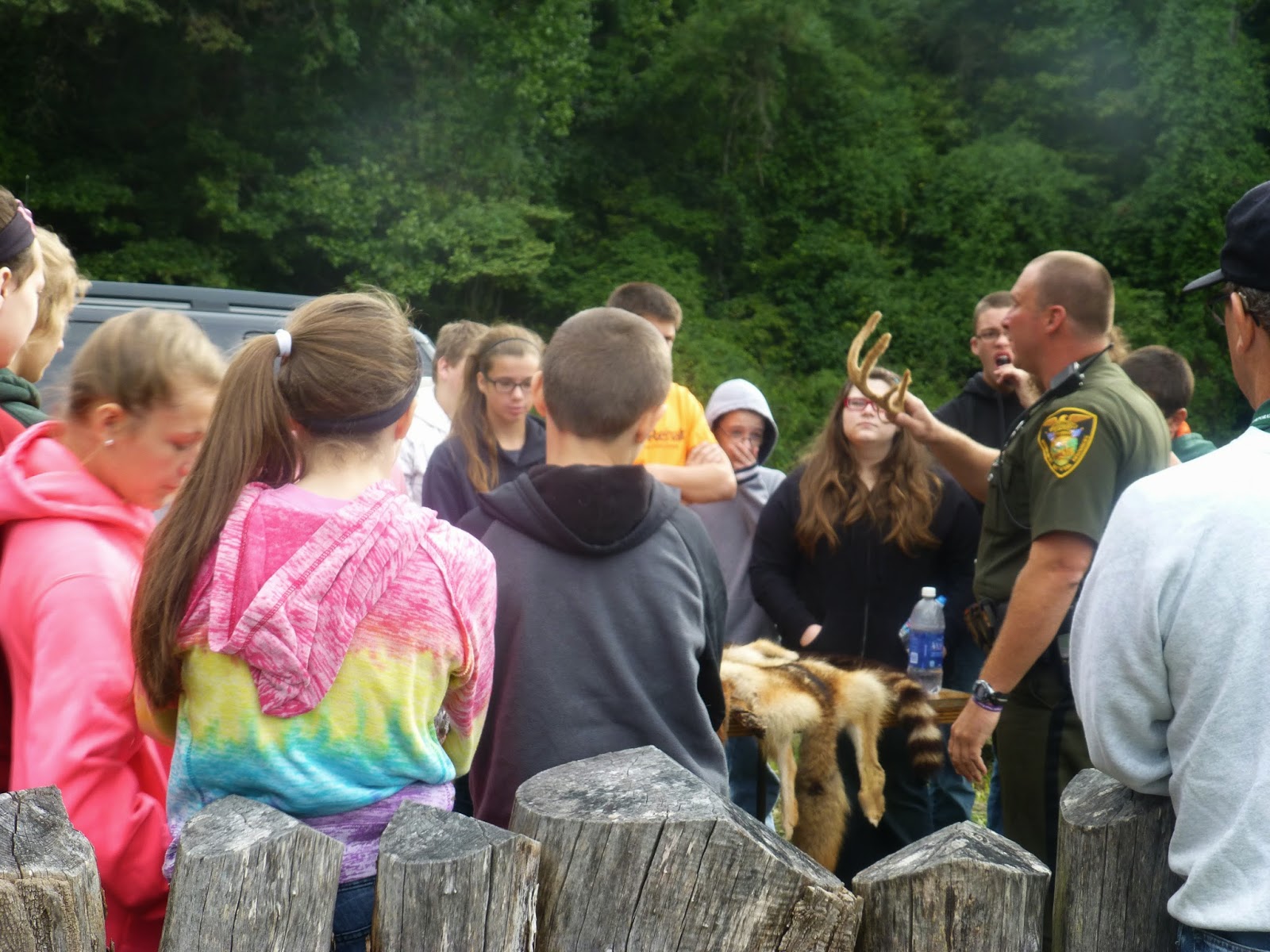
Other presentations at the event were quite varied. Students learned and tried many other things new to most of them. Another station where history and nature obviously met was one about animals on our early frontier.


The 8th graders also learned about Native Americans during this historical period. The lives of Native Americans were closely linked with nature in many ways.


Other historical presentations during the two mornings included:

 The ancient skill of Archery

Surveying then and now

 The life of an 1812 soldier at Fort Knox II

 The life of a soldier's wife (Lydia Bacon) at Fort Knox II


Mustering the troops


 A visit with William Henry Harrison, Governor of the Indiana Territory


When I was not with a group, I meandered along the woods' edge.
Goldenrod and White Snakeroot were in bloom.


Goldenrod has a number of medicinal uses that must have aided the pioneers. But White Snakeroot is known as the plant that caused the death of Abraham Lincoln's mother, Nancy Hanks Lincoln. She died after drinking milk from cows that had eaten White Snakeroot.
Students at my station also learned the importance of understanding if a plant is dangerous to our health.

Orb-weaver spiders sat in the middle of large, glistening webs:

 You can see the spinerettes on this one!

When disturbed, they tended to scuttle away and hide in nearby leaves.


Other insects were camouflaged in the leaves, such as this pale Leafhopper under a Sassafras leaf:

 
I have been to the site of Fort Knox II many times over many years. I have been involved in A Day in the Life of Fort Knox II for so long. I have also visited or been involved in, for many years, Muster on the Wabash on the first weekend in November, when the event backdrop is a blaze of the wonderful colors of an Indiana autumn. I have simply strolled the grounds, finding what trees are all around, seeing what is blooming or in fruit, looking for the little things, or spying the larger animals such as deer, foxes and turkeys. I have just rested on a seat overlooking the hillside and river, imagining voyageurs, Native Americans and others plying the water in various kinds of boats.


So much history has happened here on this hill above the Wabash River. In so many ways, people were affected by the natural environment here, and also had their affect upon it.

It is now a peaceful place, devoid of the activity of soldiers, the sounds of gunfire, the agony of injury and death, the terrible excitement of heading north for battle. That human history is now interpreted for visitors, while natural history continues, going about its business. It has been a long time since this place has been affected by the battles waged by human beings, but the struggle of everyday life in the natural world, predator and prey, survival, competition, goes on, mostly unseen by human eyes.