Friday, March 21, 2014

Word Pictures Near the Vernal Equinox


Word Pictures Near the Vernal Equinox
March 18, 2014

I step outside the porch door to call in a cat, but am drawn further into the cold night and fresh, open air.  I walk out under a sky of bright stars, the Big Dipper right over my head.  It looks as if the ceiling is a big, deep blue sheet of paper full of holes pricked into it, with a bright light shining through from behind. 
I look to the east. The Full Worm Moon is hanging low, with perfectly sharp edges.  Its glow is a hot, yellowish white, glaring, yet cool at the same time.  I warms me throughout.  The circle is broken by the dark silhouettes of tree limbs and branches.  A hazy glow surrounds the moon, stretching and fading far into space around it. The rest of the sky does not look black as it does on moonless nights.  It is a deep version of that crayon color called Cadet Blue, found only in the box of 64. 
A sharp sound comes from the same direction. Chorus Frogs are calling from the pond behind the house across the road, that frantic, slippery call of the mating season.  It seems amazing to me that I can hear them so clearly, from so far away, when I know that each one is so tiny that it is difficult to find.  I also know that if I were over there, the sound of all of them together would make my ears ring loudly. 
My focus shoots through the night, across the gardens, across the road, to one little spot among the old cat-tail stalks, where one tiny Chorus frog inflates his throat sac to almost half the size of his body, a sudden thin bubblegum bubble that creates a sound so suddenly strident that it is startling.
I pull my senses back to the present, to this spot.  But then my focus is brought to the southwest, across our farm field full of corn stubble, across the tree line on the far side, across the next farm field, and into the far tree line on the opposite side.  A pin prick of sound comes from there - “peeeent!”  Then again, from another dark space in the trees, and again - “peeeent!” And then I hear that other sound, the distinctive, far-away whistle. I know I would be seeing a male Woodcock on the upward spiral of his mating flight, wings whistling in the cold darkness.  A little while later I hear another “peeeent!”
I pull my senses back again to the spot where I stand, and then turn to the moon again in the east.  I try to drink in the memory of that brilliant orb.  I can almost see the buds swelling on the dark tree branches.
How different this will all look a month from now, the view obscured by the dense mist of new leaves.
I walk to the edge of the woods to find out if frogs are calling from Cottonwood Pond.  But, my dogs hear me, and don't know it's me.  Always on the job, they snarl, growl and bark in low, guttural voices, and are almost instantly at the fence. 
I reassure them, and they are relieved and happy.  I go back into the house, leaving the quiet night outside.

Monday, March 10, 2014

The River Meets the River Fishing Trail


The River Meets the River Fishing Trail
Ouabache Trails Park
February 23, 2014

I had not taken the River Fishing Trail at Ouabache Trails Park in some time, and I do like to check on it now and then. It is a mostly wide trail, in parts almost as wide as a single lane road. It starts near the main park road, goes down some steps, through a tunnel under the railroad tracks, up some steep steps, and continues on, roughly parallel with a deep creek that eventually flows into the Wabash River.

 
Rather, it normally goes down the steps and through the tunnel. On this day, like so many in recent times, you would not be able to take that “trail” without a boat. Even at that, it's sometimes not possible to fit between the water and the top of the tunnel.
Last spring there was a huge flood, maybe the largest I had seen at the park. The flood water was backed up all the way to the above-mentioned road, and eventually went well over it.

 The creek normally flows through a culvert under the road. Here is a view of the creek bed on the other side.

The railroad tunnel was invisible last spring. I don't know if the water ever went over the railroad tracks, because it became impossible to enter this part of the park.
I do remember many times walking the trail through the tunnel, dry-footed, and watching schools of minnows dart in the very small creek that always runs to one side. In the last year or two, I've hardly been able to use it, though once I could carefully walk a very narrow, rather muddy strip along one side of the tunnel.
Today I, like anyone else, had to go uphill a bit, where that woven-wire fence can be seen in the tunnel photo, to the gated area next to the tracks, where a cord stretches across an opening, bedecked with yellow tags and warning signs (put there by the railroad company), then gingerly straddle over the cord, go over the tracks, and end up where the trail meets the top of the steep steps (there, I said it – they can arrest me now).


Continuing up the River Fishing Trail a little ways, I looked back to see a very swollen, icy creek coming through the other side of the tunnel. It is well beyond either side of the structure, where it normally is a tiny stream entering the far right side of the tunnel.


Downhill to my left, I saw the creek a little further downstream. Normally, the creek channel has somewhat steep sides, and few spots where a person could easily work a way down to the creek water. Also, I saw that one tree had a small circle of land around it, a tiny island in the creek.
I also saw that the dreaded invasive Winter Creeper (Euonymus fortuneii) had invaded the trees and ground in this trail and creek area. I was not too surprised, as it is near an edge (where birds are more likely to land and deposit Winter Creeper seeds that they gobbled up in berries elsewhere), and it is near the railroad.  So many seeds and bits of plant material are carried and dropped by moving trains.


This part of the creek had been forming an oxbow. With so much flooding, so often, I wondered if it wouldn't take much longer for those two close sections of creek to eat away at that narrow bit of land and then connect.
In the foreground is a railroad artifact.


Looking ahead, I could see the flood waters spread out, the creek becoming indistinct as it headed toward the river. It looked less like a creek and more like a bayou.
Usually, as it nears the river, the channel becomes very steep-sided and the water well below. I wondered what it looked like at the river end.


To my right was an area I have often stepped into in order to examine wildflowers closely. The landscape on this cold winter day was all shades of gray and brown, with some brushes of blue in the sky and a more subdued blue where water reflected sky. There was a lot of blue-gray and gray-blue over the ground.
My eye went immediately to a bright crimson spot among  the gray, brown and blue-gray:  a male Cardinal resting on a fallen tree.


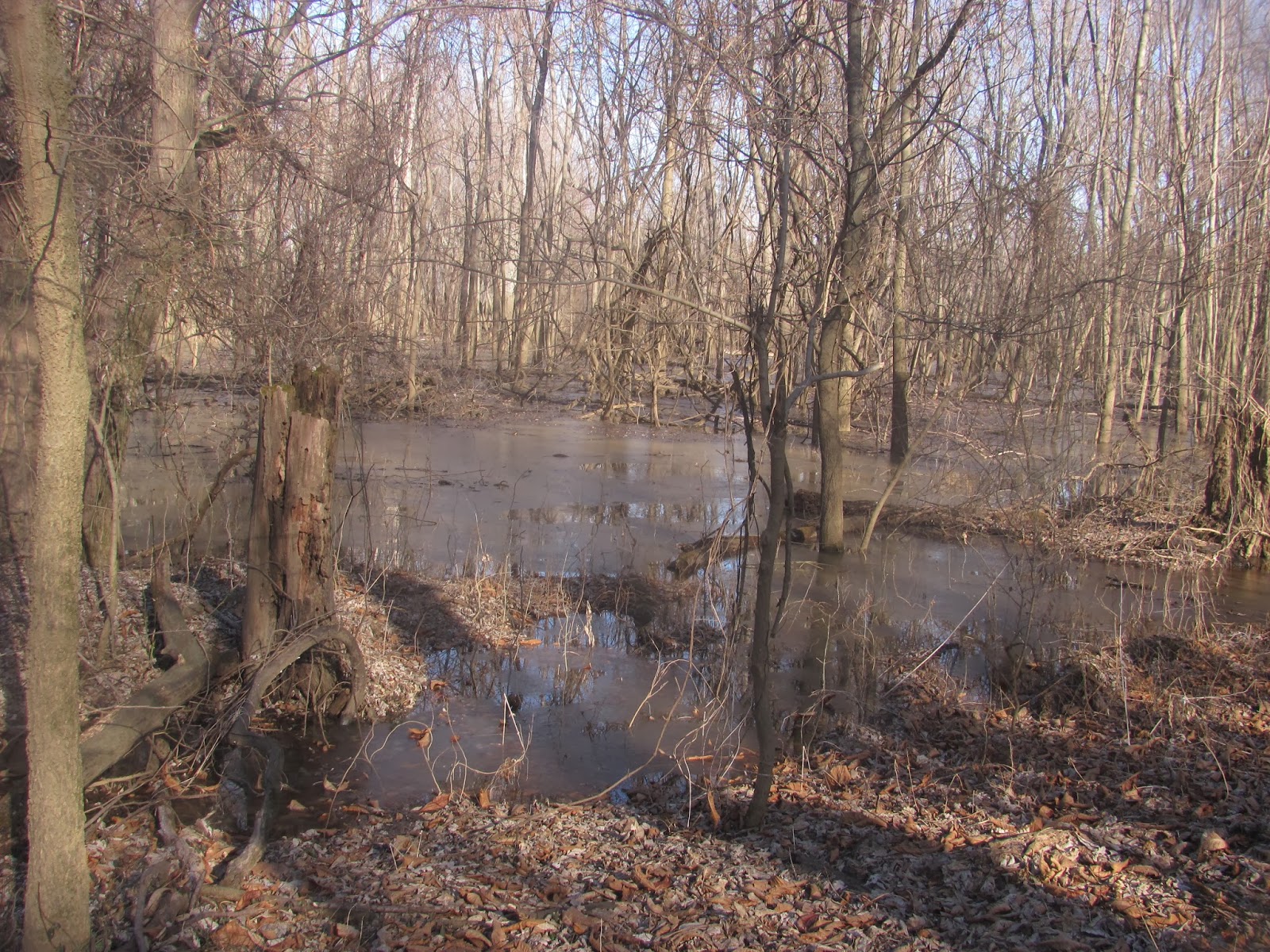
Just a little further along, the scene to my right looked more like a large swamp than the usual semi-dry floodplain forest.  Again, these were areas where I had walked and roamed, finding interesting plants and mushrooms, and watching wildlife.


To my left there was much more “swamp”. This looked deeper because it included the big creek channel.  It looked more like a place where one might see the top of an alligator's head poking through a clear spot.


 I wondered how many fish, and what kinds, might be down there well below the surface of thin ice.


In places, the movement of water was frozen into interesting designs.
A little farther, just a little further along the trail, and …


… the trail had disappeared into the swamp-like landscape.
I obviously could not go all the way down to see the Wabash River, to see how it looked that day.
The Wabash River came to me.


Blue in the distance, above and beyond the thick tree line, was the sky above the Wabash River.


I walked to the last tip of land, the farthest I could go on the River Fishing Trail. Looking beyond this point, I could not even remember in which direction the trail winds its way toward the river.


To my right, up ahead, not far from the river, I saw some floodplain forest where my friend Angie and I had roamed last autumn, taking photos of a Whitetail buck that was trying to hide behind one of the trees.
Somewhere in this area were huge patches of Lizard Tail. Last summer, the numerous blooms on the numerous “tails” sent out a heady scent.

There had been much snow over the winter, with a much greater amount in places north.  There had also been a melting period not long before my walk, as well as storms and strong rains throughout much of Indiana.  This is the Lower Wabash Valley, which swells and fills up with the melt water and rains pouring in from all points along the great Wabash River, as it winds from northeastern Indiana, across the state, and a long way south on its way to the Ohio River.
The flooding was far from over.

Well, that was a short walk, but a rather interesting one, with a sort of terrible beauty. The power of water is an incredible force.


I headed back up the trail, upstream. The sun glittered off of the wide, icy top of the creek.  It was easy to find the tunnel and railroad in the distance because the sun was also glinting brightly off of the slick metal of a track.

I am a person who constantly wonders “how” and “why”. I wondered how the floods would affect wildlife here in both positive and negative ways. It will certainly create more dead wood for insect-hunters and cavity nesters. I wondered how long it will take for the oxbow part of the creek to connect.  I wondered how long it will take the water to recede and the ground to be less than mucky. I wondered how much higher the river and flood water might get as more snow would melt around the more northerly river channels and tributaries, and how much water future storms will add, all along the river. I wondered how populations of moisture-loving creatures and plants would be affected by being so long under water instead of in seeps, shallows, and mud. I wondered what the river looked like from the vantage point of this trail, and if Bald Eagles were dipping from tops of trees to the river, and if Great Blue Herons were able to find an edge to step to or a snag to stand on, in search of food.

I wondered if it will flood enough this year to go over the railroad.

 
 I wondered how this old railroad spike came to the center of this old stump.

Wednesday, February 26, 2014

A Walk in the Woods with Silas


A Walk in the Woods with Silas
Home Woods
February 3, 2014


Our cat Silas likes to go on walks with m in our home woods.  On this very cold February day, Silas and I roamed the woods, our feet stepping over frozen ground, moving through crackling brush and over sparkling, icy creeks.

Silas helps in a number of ways.


Silas and I went down the slope from the edge of the woods and headed for a spot that I call Cottonwood Pond (for the story of Cottonwood Pond, see my blog at http://www.cottonwoodpond.blogspot.com ). 
 This was our starting point, and a good place to explore.  Silas walked across the icy surface of the pond to do his own exploring.

This is one of the ways he is helpful:  he can walk in places where I cannot.  That ice was too thin to hold the weight of a human.


We headed back up the slope at an angle to check out one of our favorite, mysterious places – a worn animal trail.  I have been watching this trail for a year or so.  It meanders gently up the slope, almost to  the top, where there is a den.


I should not say “meander”.  The animal seems to take a “path of least resistance”, and describes a trail that goes uphill with the least amount of effort.  Like other wild animals, this animal gets the job done efficiently.  This probably also enables it to get to and from the den quickly when danger is near.


Sometimes I find tracks on this trail, in the mud, in the dust, frozen in, or in snow.  Though they are sometimes obscured, I know I am seeing more than one kind of track, including that of a coyote.  Either this trail is an easy route for other animals to use, or something is keeping track of our denizen.


We were almost to the top...


… and Silas was picking up the scent.  
 His olfactory senses and his keen awareness are sharper than mine.  That is another way that he is helpful.


The trail headed straight to this hole in the bottom of a young Hackberry tree.


This hole was too small for Raccoon, Opossum or Skunk, and certainly too small for a Coyote.  So far, I  suspected Squirrel, but time will tell.  What I would really like to do is spend time within view of this den, when it is not bitter cold outside, and just sit and watch.


This tree is not far from the edge of the woods, behind the barn.  At that place, Richard had piled a lot of debris, mostly limbs from White Pine trees that we had to cut down.  Debris has been caught up against and behind this young Hackberry.


This great pile of debris has provided habitat for wildlife.  Some deep holes have appeared in the pile, behind the tree.  These holes look full of purpose, rather than coincidental. 
 I wondered if all of the dens are home to the same kind of animal.  I also wondered where the hole in the tree leads.  Is it connected with the other dens in the debris?  Does it have a rear tunnel?


Silas did his own investigation.


Another worn trail led away from the tree in the other direction.

 The trail leaving the den area


This trail went under an old wire fence (years ago, this fence divided the woods into where our sheep were allowed to roam and where they weren't allowed to go.)  

Where did it go from here, Silas?

Under the fence, and then the trail begins to fade.  From here, the animal must have been taking off in various directions, instead of wearing a single path.  


The path got very vague at this juncture, but the animal seemed to enjoy being among the trees.


I can be as distracted and as focused as a cat. 
My eye caught something that looked like shiny, wrinkled brown glass, the color of root beer.  Jelly fungus, when frozen, became translucent.


Animal trails lead you to interesting places.  This low, wet area, a little bit swampy, should be full of frogs in the spring.


I found some little pellets nearby, full of plant material.  I assumed they came from a rabbit. I wondered if Silas had picked up rabbit scent?


I came upon another den associated with a tree, this time a long dead, fallen tree.  An animal had obviously dug well into the dirt caught in the tree's root system.  This hole was much larger than any holes in and around the Hackberry.  Could it be Groundhog?


There was a frozen track nearby, but it didn't tell me much.


So, of course, Silas investigated.  

Another way he is helpful is to get into spaces where I can't fit.  But, even if I was small enough, I would not have gone in.  Who knows what might be in there?  I am curious, but not quite as curious as a cat.

Not knowing who the den belonged to, it would be hard to say who would win in an altercation, Silas or the denizen.  Fortunately, he did not go any farther.  

This shows another way that Silas helps on a woods walk:  he provides a scale of measure for the size of things like animal dens.


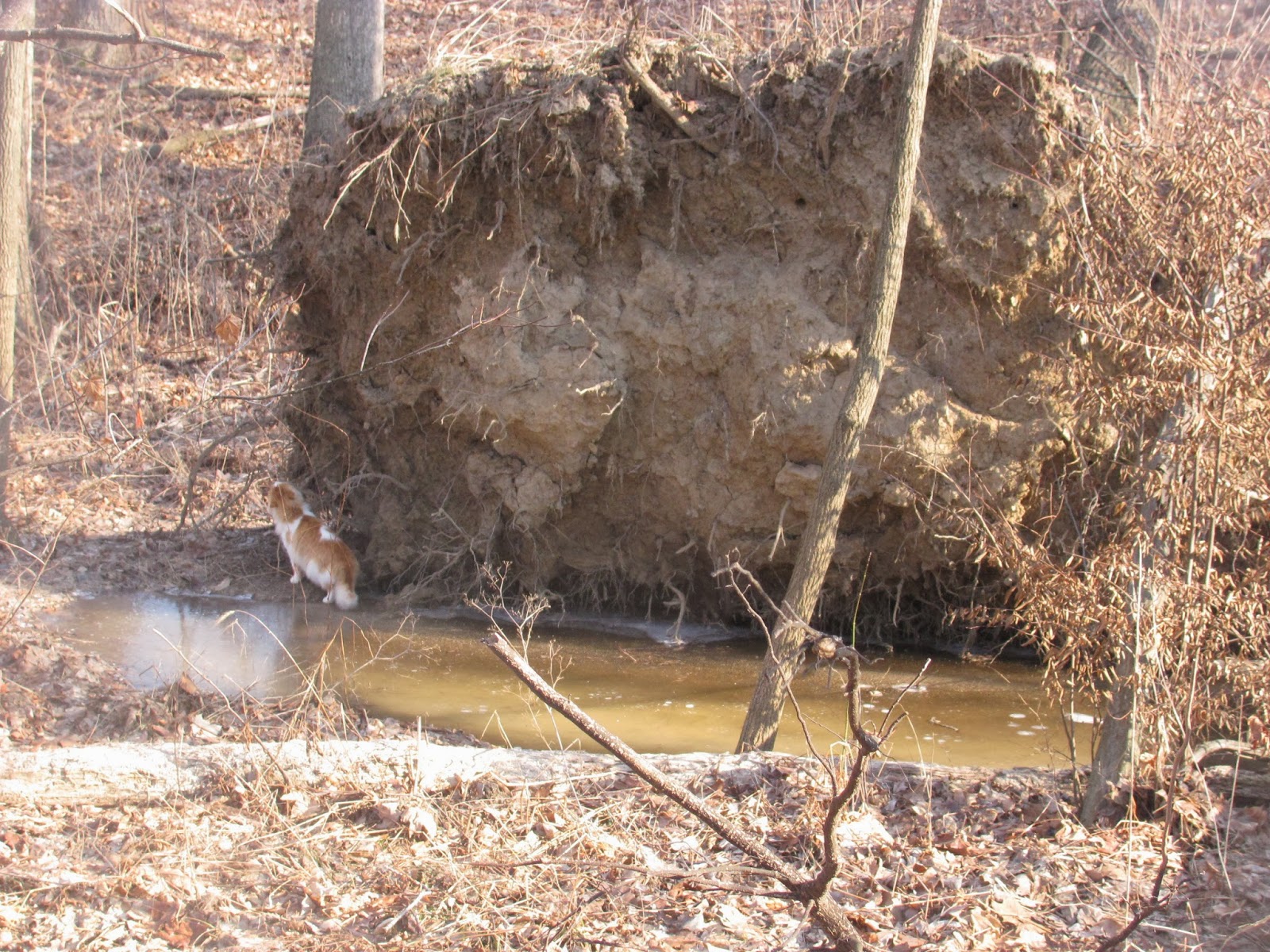
Ahead, I saw a huge root mass where a Cottonwood had fallen.  I had not noticed this huge root mass before.  


By the root mass, I found a deep gorge where a creek had been cutting down through the earth.  It must have undercut the Cottonwood a great deal and caused the roots to loosen their hold on what little ground was left below them.


For our woods, this was a deep gorge.
I did not remember seeing such a deep gorge this far into the woods.  The storms and heavy rains in recent times must have worked quickly.  It was destined to become the Grand Canyon of Our Home Woods.

The root mass and the large hole it left behind.


Once again, Silas helped by providing a scale of size, and went where I cannot reach.


I heard music, and found the babbling creek water singing melodically where it entered the gorge, obscured by debris.


Silas then went to measure the size of a nearby, upright Cottonwood, for comparison.


We reached the edge of this section of woodland.  Between it and the edge of the farm field, a grove of saplings has taken over, mostly Sassafras.  This area used to be clear, and was grazed by sheep.
Another old fallen giant lay on the ground before the young grove, with one great limb extended.


Silas can provide a scale of measure for the limb's thickness, the length of the limb, the height of the limb from the ground, the angle made by limb and ground, and even the area of the triangular space made by them.
What a smart cat!


We turned back toward the east and walked through the space between the woods' edge and farm edge.  At the opposite end was another grove of saplings.


We reached a corner where a fence used to keep sheep out of this part of the woods.  Some wire fencing remained.  It looked like an agricultural artifact, but to me it did not seem that long ago that we put up the fence.  I could still picture sheep here on this stretch of ground.


In time, fences don't matter. Creeks cut deep gorges beneath them that even Whitetail Deer can go through. I would be able to go through this spot, too, if I got close enough to the ground, but I did not try on this day.  Silas, of course, would be able to go under with ease.


A fence was here, too, but the fence line became covered with brambles, young Red Cedar trees, and deciduous saplings.  Nature takes over very quickly, and provides more food and shelter for wildlife.


Silas walked down an old fallen tree that had once stood at woods' edge.  Here, he was in view of some yellow insulators left of a pole from the former electric fence. Another artifact.


We came to a triple-trunked Red Oak tree that seemed to be holding water.


A pool of water had collected in the cup-like space between the three trunks.  Frozen within was the water's own collection.  Were those scat, or owl pellets?  There were also bright red seeds, probably deposited by a bird (and, unfortunately, from an invasive plant specie).  This tree seemed to be a favorite resting place.

In folklore, water collected in places such as this is considered magical, or to have special healing power.  
 This was another place to watch.


We came to a Black Cherry tree with clusters of amber on it.  There were also some small holes.  It was likely that a Yellow-Bellied Sapsucker (a type of  Woodpecker) had been drilling holes in the tree.  This caused the sap to exude.  The sap provides much needed sugar and energy in the middle of the winter for woodpeckers and other wildlife.  On warmer days, it will also collect bugs for them.


Silas and I headed into the heart of the woods again, along the frozen creek...

...past frozen mushrooms...


...past hollow logs...


...past more possibilities of animal dens...


...and then headed up the slope and back to the house.


I'm sure Silas will walk with me another time. 
 But, it was time for someone to go take a nap.