Tuesday, July 2, 2024

Pandemic Discoveries: Part III (Finale)


Pandemic Discoveries #3

Bedrock Bend

Home Woods

Discovery made: 2021

Written in: 2024


Approaching Bedrock Bend on October 25, 2023


Silas at Bedrock Bend on March 31, 2021


Loose rocks in creek below bedrock layers on March 31, 2021


Well, I'm not sure what happened there, how so much time slipped by between Pandemic Discovery #2 and Pandemic Discovery #3, but there you have it. I suppose it had to do with coming out of that period and having to jump back into what some call “normal”, but which I call “The craziness I lived before then.” Other aspects of life grabbed me by the collar, the shirt-tail, the belt, the ponytail, and dragged me away from writing projects.


So here I am, back again, after resurfacing from the craziness and trying to leave parts of it behind.


Let's get back to those discoveries. Pandemic Discovery #3 is different from #1 and #2 in a number of ways. The most obvious is that #1 and #2 were about plants. But #3 is about something foundational to all of the present-day plants in my woods, and to the soil that supports them. It's alive, too, but in a different way.


Under all of these plants and soil is … bedrock.


But why be so excited about bedrock? All over Indiana there are many areas of visible bedrock. Sometimes you drive through them where highways were cut through hills. You see buildings all over (and well beyond our state) made of Indiana limestone. You can enter caves through bedrock in Indiana.


But that's because not all of Indiana was created equally. So many changes took place – continental drift, major uplifts, erosion, sedimentation, glaciation, outwash, more erosion – creating vastly different kinds of topography throughout the state (no, Indiana is not all flat cornfields and racetracks …).


Why get excited about bedrock?


Well, for one thing, we rarely see it in Knox County, here in the southwest portion of the state. At Ouabache Trails Park, about 6 or 7 miles north of the Home Woods, the “big creek” eventually cuts through a valley between high sides, relatively low “cliffs”. Once every several years or so, the creek runs so high that it reaches the tops of the cliffs. At those times you can't even see the bridge going across the creek. At those times, the rushing water, which eventually reaches the Wabash River, carves out the valley and gnaws away at the cliff sides even more.


When it does so, it exposes even more of the … bedrock … that lines the valley. This bedrock, so unusual to see exposed in Knox County, is ancient sandstone, created from sediment deposited during the Pennsylvanian Period. This sandstone is of the McLeansboro Group of this period.


I tell people that if they want to see bedrock in Knox County, go down to the “big creek” at Ouabache Trails Park. You can touch rock formed 30,000 years ago that is always under our feet, but otherwise covered by so much glacial outwash that we don't see it.


But here it is, bedrock, in the Home Woods.


Yes! That's Pandemic Discovery #3!


On February 28, 2021, a rushing, swollen creek obscured the view of bedrock layers. But rushing water, over the years, caused the layers to become exposed. I would discover Bedrock Bend later in the year.


Even after the bedrock has been exposed, it still becomes obscured by layers of fallen leaves during later autumn, as it is here on November 2, 2022.


I was on one of my little exploratory rambles, following our little creek after it passes Cottonwood Pond (see my blog “Cottonwood Pond”.) That little creek (with some tributaries), through the bottom of our little woods, does some twisting and turning, getting deeper and wider. After cutting deeply through our property, it ambles on through other countryside, twisting and turning even more, until it empties into the “River Deshee”, or “Riviere du Chien.”


The creek in the Home Woods, just downstream from Bedrock Bend. After this winding, it turns to the west, becoming deeper as it goes, cutting through the soil layers. The water finds its way, eventually, to the River Deshee.
Photo taken on March 30, 2023


But, back to my ambles along our little creek, where it winds through mainly mud and cut-aways of soil that reveal tree and other plant roots. Any debris in the creek bed (pebbles, gravel, bits of broken crockery, broken bottles, an occasional beer can, a soccer ball, etc.) tend to originate somewhere way upstream, somewhere up from the other side of the road, through the old homeplace of the neighbors' property and further up from there, or they are items lost or tossed from the road that work their way down. Much of the gravel probably came down from road work and construction projects, trucked in from elsewhere.


Piece of dish found in the creek bed on July 10, 2023 - probably washed down over the years from an old home site across the road.


October 25, 2023: It's kind of a mystery to me, how some good-sized, heavy, rounded rocks have made their way this far down the creek (this is at Bedrock Bend), and where they originated.


Almost to Bedrock Bend on October 25, 2023

Again, I was ambling and exploring down the creek, getting to a spot where it makes a relatively sharp turn. This spot is also deeper, and is steeper on one side. Over the years, the creek has carved away at that bank, cutting into it. The bank is part of the hill that starts below our barn area. As the water has carved this side, it has exposed many roots and weakened the root system of a tree that fell over the creek, its limbs and branches splayed across. Below this jumble is a pool that, during wet times, is deep enough to hold some life. In fact, on this day there were the ker-plunks of Green Frogs, and I saw a couple of them. Their tadpoles need deep enough water that is present long enough for these somewhat large frogs to develop, so this pool had maintained its cool, shady depth all spring and into summer. Sometimes it does dry up, but not often.


March 6, 2024: A peek at the deep pool at the bend.


Mushrooms on a log at Bedrock Bend (over the creek) on a very wet day - November 2, 2022.


Moss, with sporophytes, growing on a log at Bedrock Bend on March 30, 2023.


Lichens on an old stick on the creek, next to Bedrock Bend, on March 6, 2024


April 15, 2024: Looking toward the location of Bedrock Bend. Across the vegetation in the foreground can be seen patches of pale lavender Woodland Phlox and deep purple Dwarf Larkspur. 


I lingered there a bit, looking for frogs, examining moss and fungi on the fallen limbs, looking into the gravel that gathers here, when … what to my wondering (wandering) eyes did appear? Did I really see what I thought I was seeing?


Can you find it??


Rock!!


March 30, 2023

Actual rock! In our woods! Bedrock! Layers of rock at the bottom of the cut, just above the water.

And I mean … layers. The rock was obviously layered – layers and layers of grayish-brown rock, broken here and there. Definite fissures. Various sedimentary rock words came forth from my head: shale, siltstone, mudstone. My Earth Science background from way back was starting to come forward, and I was happy to meet it again. It was gradually uncovered, layer-by-layer, like water revealing layers of bedrock.


March 30, 2023 - layers and layers ...


Below the exposure, on top of the gravel, some under flowing water, were flat, gray rocks. Some were shaped like various states, including Indiana, though that one needed a piece broken of the top left corner to accommodate the southern tip of Lake Michigan, from where I hail.


I don't know ... maybe this one resembles Illinois more than Indiana ...


I picked up one rock that was larger than my palm and I was acutely aware of having in my hand a piece of rock formed, how many years ago?, in a spot where it has never before been seen by humans. When I ran my thumb over the wet rock, some “mud” appeared. No grains were visible, which left out sandstone, though I already figured it wasn't that. They were extremely fine, essentially undefinable grains.


I put pressure on the rock and it broke easily, revealing layers along the broken edges. “Friable” was the word that came from my past brain. This rock is very friable, meaning it breaks apart easily.

But, what is it? Shale? Siltstone? Claystone? Mudstone?


I looked up descriptions on geologyscience.com and ruled out mudstone, which is, of course, hardened mud. It is a mixture of silt- and clay-sized particles (too small to see), which would fit with this rock. But, mudstone breaks off in blocky pieces, not flat ones. Claystone has clay-sized particles and is “lithified, non-fissile mudrock”. “Lithified” just means sediments that were transformed into stone. But that “non-fissile” part ruled out Claystone. This rock is definitely “fissile”, meaning it splits easily (not just simply breaking easily). Fissile. Another word in my past brain.

Now I was down to Siltstone and Shale. Which is it? In Siltstone, “more than half of the composition is silt-sized particles.” Well, that sounds kind of general. I found more information in Geology.com: “It forms where water, wind, or ice deposits silt, and the silt is then compacted and cemented into a rock.” “It represents a level of current, wave, or wind energy between where sand and mud accumulated.” Well, that sounds possible, given what I've learned about formations in our area. “Sedimentary structures such as layering, cross-bedding, ripple marks, erosional contacts, and fossils provide evidence of these environments.”


Whoa! Look at the ripple marks on this rock!


We are seeing evidence of the action of water on sediments – how many years ago??

But it also says “Siltstone is much less common than sandstone and shale. The rock units are usually thinner and less extensive. Only rarely is one notable enough to merit a stratigraphic name.”

Huh. Well, I have no idea how thick this bedrock layer is, since this top part of it has been only recently revealed. Is it a “notable” layer, with a name? Or too thin to merit one? Or is it even Siltstone?

What about Shale?

From geologyscience.com I find that Shale will “break into thin chips with roughly parallel tops and bottoms.” That's true of my rocks. But, how thin is “thin”? I have so many questions. So much is relative, and the items that are very specific (like measurements of particle size) are things I don't have the resources to determine.


March 6, 2024: Layers breaking up and starting to be pushed downstream.


March 6, 2024


They also say, “Shale is characterized by breaks along thin laminae or parallel layering or bedding less than one centimeter in thickness, called fissility. It is the most common sedimentary rock.”


March 30, 2023


March 30, 2023: Bedrock layers separating under the creek water.


October 25, 2023
Removing a layer.


October 25, 2023


October 25, 2023 - Like an open book.


This certainly sounds like my rock, too.

So, is my bedrock the “much less common” Siltstone? Or is it the “most common” Shale?

It goes without saying that I'd like for my bedrock to be less common and more special. But, I'm stumped at this point (my past brain doesn't go quite far enough), so I'll be consulting geology friends and will add an update to this blog post when I find out the truth.

Meanwhile you, dear readers, shall remain on the edge of your seats, waiting to hear how common is my bedrock.

The Pennsylvanian bedrock was lain atop of a Precambrian metamorphic and igneous “basement complex” - in other words the first, original rock formed by fire, upheaval, etc.. The Precambrian is 9,000 to 10,000 feet thick in our part of the country, the oldest rock in Indiana, and was formed billions of years ago.

After the Precambrian Era came the Paleozoic Era, consisting of seven Periods (from oldest to youngest: Cambrian, Ordovician, Silurian, Devonian, Mississippian, Pennsylvanian, and Permian.) During those first Periods, starting with the Cambrian about 570 million years ago, through the Mississippian, ending about 320 million years ago, what is now Indiana, plus much of inland North America, was under the sea! Though levels fluctuated over the years, this sea was usually a shallow one, with sediments (and remains of sea creatures, which became fossils) collecting along the way.


Getting gradually closer to Bedrock Bend …


During the second-to-last Period of the Paleozoic Era, the Pennsylvanian Period, starting about 320 million years ago, what is now Indiana was not only located near the Equator (think about that … ), it also was then above sea level. Our area consisted of large rivers and swamp forests then (and, yes, there are some places here that still seem that way, and in the summertime still feel rather tropical, so you can imagine yourself back in the Pennsylvanian Period … ). During this period, lasting to about 299 million years ago, sediments were lain that became coal, shale, sandstone, and clay. Coal eventually formed from deposits of carbon-rich sediments (by the way, my husband tells me of another creek-gouged place on our property, downstream from Bedrock Bend, where some coal is exposed! Coal has been mined beneath our place and in the general vicinity.)


Well, since the fissile rock I found at Bedrock Bend is not coal, sandstone, or clay, it must be … shale.


The Pennsylvanian Period is divided into three Groups (based on rock features) – from oldest to youngest they are; Raccoon Creek, Carbondale, McLeansboro. In my limited knowledge of this, I'm not sure what Group my place would be in, but I'm inclined to say McLeansboro. This Group is divided into four Formations: Shelburn, Patoka, Bond, and Mattoon. Again, I do not know which one contains Bedrock Bend and my place.


March 30, 2023 - Silas observing the bedrock debris that has been washing down from Bedrock Bend. You can see where the debris stops and the water becomes more clear. It will be interesting to see how much time it takes for it to get further downstream.


I would love for anyone knowledgeable in local Geology to further educate me and correct any errors, clarify any suppositions.

So, I, and we, have learned some things about the bedrock underlying my place near Verne, Indiana, of which rock is exposed at what I've dubbed Bedrock Bend.

But, getting back to a point made long ago in this blog post … why is so little bedrock exposed in Knox County?


Well, that's because … along came the glaciers, otherwise knows as the Pleistocene Epoch, or Ice Age, which started about 2.6 million years ago re-sculpting the landscape and dumping sediment and other debris during glacial movement and retreat. There is no certainty about how many glacial advances and retreats actually existed in Indiana, but there is clear evidence of two major ice sheets – the Illinoian and Wisconsinan. Before these, valleys were filled and streams diverted by ice sheets starting about 700,000 years ago, as they extended into central Indiana.

The Illinoian ice sheet existed about 300,000 to 132,000 years ago, reaching the furthest into Indiana, but going around the uplands of south central Indiana (which became known as the “Driftless Area” and is well-known for magnificent hills, valleys and rivers.) This means, of course, that the Illinoian ice sheet covered what is now Knox County, scraping it flat and depositing debris. After the retreat of this glacier, the land was exposed for about 125,000 years.

Starting about 50,000 years ago, the Wisconsinan glacial sheet advanced, managing to get south of present-day Indianapolis, so it did not reach our area.

But even the Wisconsinan had a strong effect on our area. As it (and previous ice sheets) melted and retreated, glacial meltwater dashed down valleys, reforming them, and also leaving great deposits of sand and gravel, called outwash. So, Knox County is thickly covered by glacially-deposited outwash, which led to a lucrative sand and gravel industry, and which had to be penetrated to get to coal in the bedrock (later, some wind-borne, or aeolian, silt created rich deposits of loess – some of these deposits formed hills, such as Dicksburg Hills, and the mounds that were later used by Late Woodland people.)


Layers of plants, topsoil, subsoil - we don't see the sand and gravel of glacial outwash in this spot, but all of the soil layers are sitting upon the layer of sedimentary bedrock. Our barn up there is an example of human effect on the land. We built the barn on top of an area where the previous landowner had gouged out the soil.
Photo taken March 30, 2023


Oh, here is some more vocabulary:


Lacustrine – sediments deposited in a lake or lakes

Fluvial process – erosion or deposition by a stream or river.

Fluvial landform – produced by the action of a stream

Alluvial – deposits left by running water


Over historic time (some pre-historic human time, but mostly historic), humans have affected the shape and condition of the land that was formed by all of these volcanic and uplifting and erosive and depositional and glacial processes. We have pushed and prodded, dug (sometimes very deeply) and lifted, and generally rearranged our landscape. But without our “help”, natural processes have also done their work, mainly through erosion by water and wind, creating varying conditions for different ecosystems and plants, which then make their own changes.


Humans have done some “work” on what is now our place, but it all sits on top of deep layers of sediment that collected and compacted thousands of years ago. And that sits on top of bedrock formed millions of years ago from oceanic and swampy sediments. At our place, the only way to see the bedrock is to dig way down there (as in coal mining) or for the power of water to keep working down and down through the soil and glacial layers, all the way down to those ancient rocks.


March 30, 2023: Soil layers above the bedrock, with some green plants growing on top. Root systems of trees, shrubs and other plants are visible.


And that's what happened to create Bedrock Bend, in the bottom of my little woodland, where the creek kept working away at the side of a hill. Now I can go down there and look at something that was formed about 300 million years ago, and watch frogs in the pool of water at the bend, going through their life cycle in the current year. I can pick up a flat, friable rock, possibly one shaped like Indiana, and hold deep history in my hand, find its fine sediment on my thumb, then bring it up to our house that was built less than 40 years ago, to be on display. I can point to it and say to a guest -


“This is our bedrock.”


March 30, 2023 - Two forms of life at the Creek: Bedrock from below, formed thousands of years ago, and tree seeds, catkins and leaf bud from above, fallen recently.


May 12, 2024


Some Sources:


Indiana Rocks!: A Guide to Geologic Sites in the Hoosier State; Indiana Geological and Water Survey; Mountain Press Publishing Company, Missoula, Montana; 2018.

Roadside Geology of Indiana; Mark J. Camp and Graham T. Richardson; Mountain Press Publishing Company, Missoula, Montana; 1999.

Bedrock Geologic Map of Southern Half of Knox 30-X-60-Minute Quadrangle Indiana.

IU DataCORE

datacore.iu.edu/concern/data_sets/js956f80d?

Geology.com

Geologyscience.com


October 25, 2023


Tuesday, October 26, 2021

Pandemic Discoveries: Part II


Pandemic Discoveries: Part II

Ghost Pipes

Monotropa uniflora

Home Woods

Summer 2020


Late Summer 2020


In Part I, my Pandemic Discovery, or Pandemic Surprise, was the accidental sighting of Cranefly Orchid in my Home Woods.


An even greater surprise happened during the late summer of 2020, even more unexpected than Cranefly Orchid. This discovery was a plant not often encountered, in general (though not uncommon throughout most of its range). In fact, it is often mistaken for a fungus but it is a true flowering plant.


Ghost Pipes at Dusk: Late Summer 2020


And What to My Wondering Eyes Did Appear ...

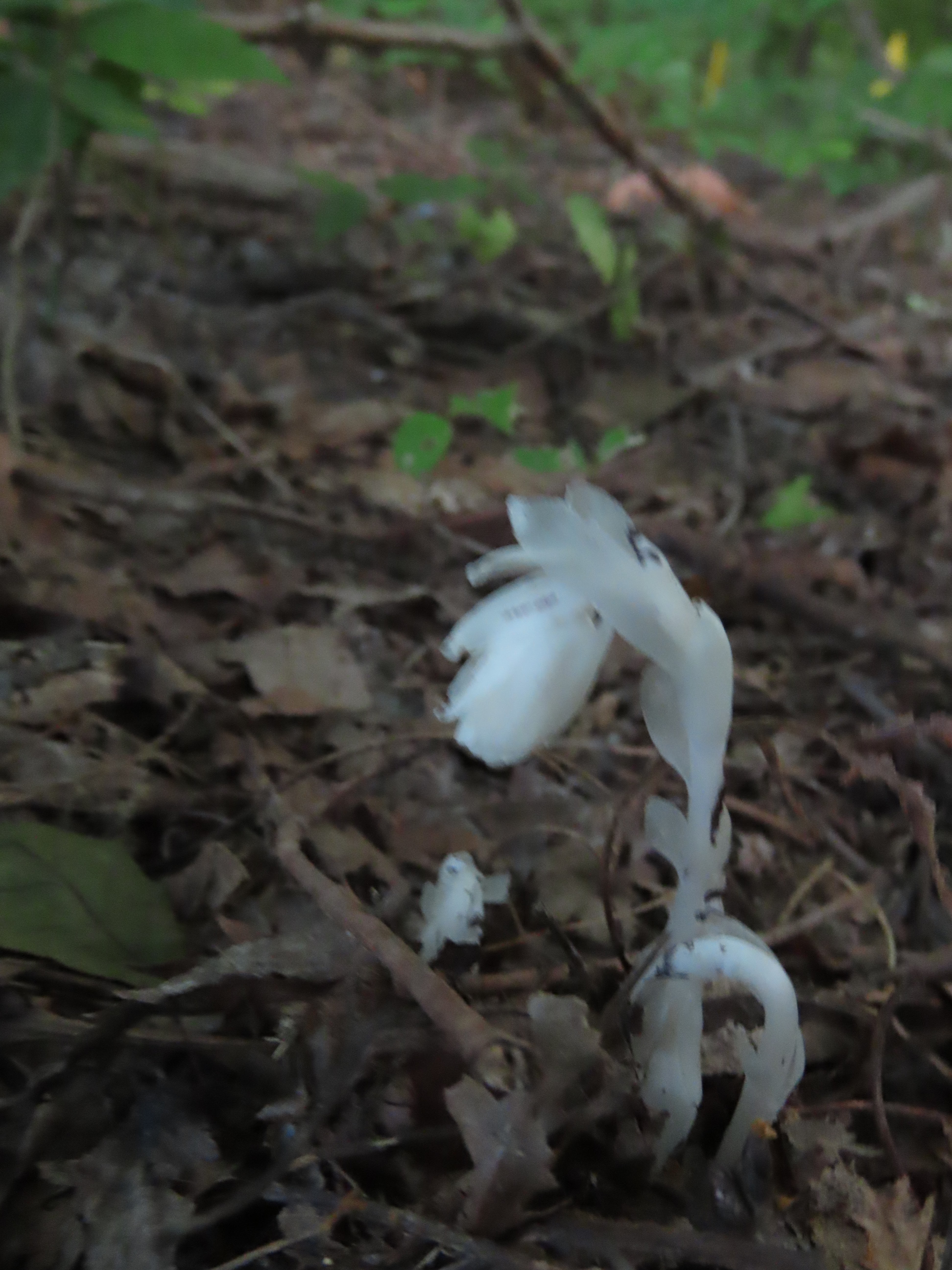
I was wandering my Home Woods in late July, 2020, near the log I had designated as my “Sit-Spot” a couple of years earlier, in the upper part of the woods. As I walked by a little almost-empty spot of ground, something caught my eyes. I think it did so because I'd never seen it in my woods before (and I know my woods very well), but I had seen it a few choice times in my life.


Little white spot on the ground


There it was, a pale stem, swollen top drooping down from the top of the stem. It seemed almost opaque, but also seemed to glow there against the cocoa-colored ground.


Could it be?? I moved in closer, carefully. [gasp!] Yes!! Ghost Pipes!!!


They are ghostly-looking things, especially turning up in an unexpected spot. And, there were more coming up!


I took photos to share with friends, but also to prove to myself that they were truly there. A couple of friends, Gary and Lisa, saw my photos, contacted me, and came out to see the plants, as excited as I was. We dipped into the edge of the woods, went down the slope, hopped the creek near Cottonwood Pond, worked our way up the next slope, and walked to the shady spot, where these pale plants were clustered, like an anomaly. Gary and Lisa stayed there awhile admiring the plants and taking photos from various angles.


I went to the spot periodically to check on the Ghost Pipes. Some more showed up in the cluster, pulling their heads from the soil.


Through the Ghost Pipes season ...


I was able to watch them in each stage of growth – as white bumps at the soil line growing larger, then as an inverted U shape, then the flower head pulled from the ground while the plant was still bent, then the stem straightening, holding its flower head like a handkerchief held by fingertips.


What's in a Name?

My preferred common name for them is Ghost Pipes because that encompasses the ghostly appearance as well as the shape of the plant. A more common common name, the one I'd mainly heard from childhood on, is Indian Pipes. This is presumably due to a resemblance to Native American peace pipes. But, the name is a remnant of those times when anything Native American was called “Indian”, used in trite, repetitive ways that almost never reflected knowledge or understanding. So, I don't like to use the name “Indian Pipes”.

There is also the name One-Flowered Indian Pipe. Also Ghost Plant, Ghost Flower (though at least one other kind of plant is called that), Corpse Plant (I have to say I'm intrigued by that one – maybe I could go as a Corpse Plant for Halloween) and Ice Plant – all very descriptive. Most people would be puzzled by the name Bird's Nest, but it refers to the dense, tangled mass of roots that we don't see unless we dig up the plant (note: never did up this plant – more on that later).

The name One-Flowered Indian Pipe is the common name that comes closest to the meaning of the botanical name. The genus name Monotropa translates as “one-turn”, referring to the one down-turn of the stem, it's pipe-like shape. The specific name uniflora, as you might guess, means “one flower”, since each stem just has one flower (a very similar species, Monotropa hypopitys, or Pinesap, has multiple flower heads on each stem and tends to be more colorful).

Monotropa uniflora is a perennial plant, giving me more hope that I'll see it in this spot again. But, you can't just simply get one and plant it in a spot and expect it will grow there. It won't transplant well because there is a very unique relationship under the soil that is essential to Ghost Pipes' nutrition (more on that coming up).


Ghosts in the Woods

Why aren't Ghost Pipes green, like most other plants? Most plants need sunlight to prosper. Sunlight is captured by the leaves, using the green pigment chlorophyll (in the leaves' chloroplasts) to manufacture food from carbon dioxide and water, in a process called photosynthesis. This food feeds the plant, sending nutrients from leaves to roots (food is also obtained from the soil via root tips).

But Ghost Pipes, and some other plants, need no chlorophyll because they derive nutrition elsewhere. Examples of some such plants in Indiana are Beech Drops (Epifagus virginiana) and Cancer Root/Bear Corn/Squaw Root (Conopholis americana). Such plants are called heterotrophic, meaning they must get their nutrition from other organisms.

There are two groups of heterotrophs. One, parasitic plants, get their organic carbon through structures called haustoria, projections from the parasitic plant that derive nutrition directly from the green plant to which it attaches. One example is Dodder (genus Cuscuta), which has haustoria along its threadlike, twining stems that wrap around green plants. The above-mentioned Cancer Root (Conopholis americana) has haustoria on its roots that attach to the roots of some species of Oak trees.

Ghost Pipes belong to the second group of heterotrophs, called mycotrophic plants. This also includes many Orchid species. “Myco-” refers to fungus, particularly mycorrhizal fungus (you can see strands of these underground, or under the bark of dying trees or decaying logs). Mycorrhizal fungi function as the “middle man” between the green plant host and the non-green mycotrophic plant. The fungi is attached to the roots of the green plant in a beneficial, nutritional relationship, providing minerals to the plant from the soil via hyphae (fungal strands), while the green plant provides food (manufactured using sunlight) to the roots and fungi. They truly help each other out! But, the mycotrophic plant (like Ghost Pipes) comes into the situation and, essentially, parasitizes the fungal hyphae. It reverses that flow of carbon and other nutrients from the green plant, via the fungi, to its own roots! You might say it uses sunlight to get energy, but in a very convoluted, complicated way!! As one author stated, Ghost Pipes “have flipped the food chain upside down”(8)!

Ghost Pipes have a thick, tangled mass of roots that don't have to dip far into the soil (6). Instead, they tap into specific species of mycorrhizal fungi (in the family Russulaceae) that are associated with certain kinds of trees, though one article states “.. they are not always found in the company of any specific tree” (6).

I stood near my patch of Ghost Pipes and looked around at the nearby trees, wondering which tree was actually feeding this patch. The closest trees are Red Oak, White Oak, Hackberry, Black Cherry, Sassafrass, Tuliptree, White Ash, Black Walnut, Sugar Maple, and some others.


But, mostly I wondered at the amazing process going on under my feet, and that there are so many essential processes beyond our sight.


At Home in the Woods

But, how did this patch of Ghost Pipes end up here?? I hadn't seen them here before, so they hadn't come up from established roots. Seeds? The seeds of Monotropa uniflora are like dust, easily blown to places far from their source. One source (5) says that they range between 0.6-0.8 mm long. Just think of it – some dust-like seeds may have happened to land on this spot and germinated. And this spot had the right trees with just the right mycorrizal fungi associated with their roots, and the new Ghost Pipe sprouts were in just the right place.

Is that how it worked? I feel I need to learn more. And I have to wonder – from where did those seeds originate? Where was that other flower or patch? And how far away? It's not like this is a forested area. It's mainly agricultural land with patches of small woods. Or, could these fine seeds have arrived with a bird or other animal? If so, it's possible to travel farther that way.

This spot must have been just the right habitat, also. For one thing, since Ghost Pipes do not need sunlight to manufacture food, they can thrive in shady places. The article from Wild Adirondacks (11) states that it “... grows in a wide variety of well-drained, shady sites ...”. The Mountain Lake Biological Station site from Virginia (6) says they “... occur almost exclusively in rich, deciduous woods with abundant organic matter … “. Well, that describes the part of my woods where I found them, though the spot itself did not seem deep in organic matter – the soil was exposed. Homoya (1) says that they are “ … found mostly in rich mesic upland forests … “ and lists some companion plants as “Sugar Maple, Silvery Spleenwort, Anise Root, Horse Balm, Hog-Peanut”. The Sugar Maple is true for me, but not the other plants, though there are many species of woodland plants here.

Whatever happened, it seemed magical.


Family Ties

Monotropa uniflora is classified under Ericaceae, the Heath family. This is a broad family of plants that grow in many types of habitats throughout the world. Many are woody and evergreen. This varied family includes plants such as blueberry, cranberry, huckleberry, rhododendron, azalea, mountain laurel, pipsissewa, manzanita, and wintergreen. They do have a few things in common, such as 4-5 petals, 4-5 sepals, twice as many stamens as petals, fruits typically a capsule or berry, and a shallow-spreading root system (most of it within a few inches of the soil surface) with no root hairs (so, they need consistent moisture). Ghost Pipes exhibit these common characteristics, including the description of the root mass I gave earlier (it helps them to grow in that rich, shady place with plenty of organic matter, which conserves moisture near the roots).

Descriptions of Monotropa uniflora vary with sources, concerning their size, which makes me wonder if the size varies with locations within their range or with micro-habitats. Generally, the plant grows from 4”-10” tall (I did not measure mine). The stems are hairless (another difference from Pinesap) and they are cylindrical in cross-section. Along the stem are tiny, scale-like leaves (not needing to capture sunlight) and they are alternately arranged.

The plants are usually found in small clusters (like mine), though they can be alone. A friend told me of masses of them she found near Lake Michigan, so they also are not always in small clusters. The stems can break easily when new. The plant is usually white or cream-colored, sometimes with some pink hues, and sometimes with black specks.


A fresh new Ghost Pipe plant with a few little black specks


Making an Appearance

The first thing one sees of a plant is a little white bump. This is the top of the curve of stem. Eventually the top part of the stem pulls the flower head from the soil and lifts up. But, it usually keeps the flower head in that drooping position that resembles a pipe. A recent rainfall generally encourages the plants to grow and rise.


The small, scaly leaves and drooping flower head typical of Ghost Pipes.


The flower has an unusual appearance, too, besides being ghostly, as it hangs from the stem with its narrow, bell-like shape. It is “randomly symmetrical” and has no obvious floral scent. The 4-5 petals and 4-5 sepals are scale-like, from 1/2”-3/4” long, the petals longer than the sepals and also lasting longer. The petals surround ten to twelve stamens (they have the pollen) and the stamens surround a single, stout style (the part containing the ovaries).

The blooming period is variable for the cluster of plants, but not long, happening for one to two weeks. The flowers bloom anytime from early summer to early autumn. The short bloom time could be one of the reasons people do not come upon them or notice them often (besides the fact that some might think they are a fungus, not a flowering plant).

After maturity, the flower opens and rises slightly upward, preventing rain from entering the flower, but making it more accessible to pollinators. The flower is pollinated by small bumblebees, some fly species, and other nectar-seeking insects, but the bumblebee is the most important to the Ghost Pipes for dispersing pollen and cross-pollinating the flowers. Pollinators access both nectar and pollen from the flower as “floral rewards”.


Because Ghost Pipes are opaque, we can see the ovary on the inside that will become a seed capsule if it is pollinated


And, Then What?

After successful pollination, the flower head turns straight upwards and develops a five-celled seed capsule containing those tiny, fine, dust-like seeds. Seeds are dispersed by wind after the capsule opens. Though most Ghost Pipe flowers bend down from the stem until pollination, some of them may stand straight up before pollination.

I visited my patch more frequently as time went on, wanting to document every step along the way, all the way to seed capsules opening. I watched for the flower heads to stand up, the sure sign of pollination.


Later in the Ghost Pipes season - one down! 


A little later - more black spots 


And later - the plants are looking spindly and more droopy, and have more black on them


I'm sorry to say that not a single one ever stood up!! They did develop black spots, but some flowers have those, anyway. However, over time the black spots were more numerous, and getting larger.


Late Summer 2020

Notice that the number of plants in the cluster gradually decrease as more individuals fall and disintegrate


The Waning Days

When a Ghost Pipe flower is dying, it gradually turns black, shrivels, and disappears.


Late October 2020

Late October or Early November 2020


That's exactly what mine did, without ever lifting their heads. Somehow this patch was not visited by pollinators, or no insects successfully cross-pollinated the flowers. I wish I would have had more time to spend just sitting near the patch, watching, seeing if any insects visited.

Though this was a disappointment, I had hopes for seeing the plants come up again in 2021.


Encore??

When I went to the spot this past summer (2021), I saw a tiny white bump on the soil. Upon closer inspection, I determined it was a Ghost Pipe coming up!


Over time I found a few more of those white bumps. I kept checking, and some of them were starting to rise more from the soil, looking more like U-shapes. They were coming up! But, they were seeming to take a long time. Was I just being impatient, or was this a normal amount of time?


July 26, 2021


July 29, 2021


August 9, 2021

August 14, 2021 - have these been stepped on??


I did not get into the woods as often as I wanted. The next time I checked, there was nothing. Nada. Not even any little white bumps on the soil line. Not even any blackened, shriveled plants on the ground. Maybe they came up and went through their life cycle while I was gone, but it really wasn't enough time for them to have done that. I certainly would have seen, at least, residue of finished plants.


August 27, 2021


So, who knows if they will show up again next summer? I plan to do a better job of checking on them often, for one thing. And, I have hope that not really seeing them this year may not be such a bad thing. These are plants that don't come up and bloom every year, necessarily, which is another reason people don't encounter them much.


October 22, 2021 - The Sit-Spot log near the Ghost Pipes spot


I have one wire flag marking the spot. But, maybe I need to put a few flags around the spot, a good distance away from where the cluster was, but close enough together to define the spot. One thing I wondered about was whether or not the spot was damaged by someone walking over it. No one I know of has been walking in my woods this summer except the young man who is allowed to bow-hunt (or, rather, a friend of his checking his deer stands, since the young man broke his foot). This spot could be on the “trail” they use to go check the stands, and they would not have known, by a single flag, what was there. Ghost Pipes do not like to grow in disturbed areas.

Whatever the reason, I'm not giving up hope. And, even if they never come up again … that one time was really magical, and ghostly!


Sleep well through the winter and spring, Ghost Pipe roots!

**********************************************************************************

Some extra notes on Monotropa uniflora:


Uses by humans:

(Note: these are simply historical references and not meant as suggestions for treatment. Only trained and educated herbalists should suggest uses for unfamiliar plants. M. uniflora may be toxic. Also, populations should remain undisturbed and not removed for any use.)

  • (11) – Cherokee pulverized the roots to use as an anti-convulsive. Mohegans used an infusion of roots or leaves as an analgesic. Cree chewed the flowers to treat toothache.

  • (8) – A constituent in the plant acts as a nervine, sedative, and pain reliever, and it was used to treat seizures. The clear fluid from the stems was used by Native Americans to treat eye problems. M. uniflora contains salicylic acid, which can be used to treat warts.

  • (5) – Since the late 19th century, M. uniflora was used to reduce anxiety (anxiolytic)

  • (2) – Native Americans used the clear juice from the stem as eye medicine and to sharpen vision.


Uses by animals other than pollinators:

  • (4) – Thrips in the group Monotropae feed on the flowers.

  • (4) – Bears have been known to eat the plants.


Sources - Books:


(1) Homoya, Michael A.

Wildflowers and Ferns of Indiana Forests: A Field Guide

Indiana University Press; 2011


(2) Horn, Dennis, and Tavia Cathcart

Wildflowers of Tennessee, the Ohio Valley, and the Southern Appalachians

Lone Pine Publishing; 2005


Sources - Web Sites:


(3) Go Botony (New England)

https://gobotony.nativeplanttrust.org/species/monotropa/uniflora

Good for specific details of the flower (list of characteristics), photo gallery.


(4) Illinois Wildflowers

www.illinoiswildflowers.info/woodland/plants/indian_pipe.htm

Much description of plant, habitat, etc.


(5) inaturalist

https://www.inaturalist.org/taxa/49477-Monotropa-uniflora

Information (Wikipedia), photo gallery, many references.


(6) Mountain Lake Biological Station – University of Virginia

July 8, 2013

https://mlbs.virginia.edu/organism/monotropa_uniflora

Includes a photo of the stalk bases with roots and mycorrhizal fungi.


(7) Ontario Wildflowers

www.ontariowilflowers.com/main/species.php?id=197

Excellent photos, including both open and closed seed heads.


(8) Talk Plant

“Monotropa uniflora: how a plant conned fungi”

Dr. Rupesh Paudyal

May 27, 2017

www.talkplant.com/real-hustle-plant-conned-fungi


(9) Tom Volk's Fungus of the Month for October 2002 (Wisconsin)

https://botit.botony.wisc.edu/toms_fungi/oct.2002.html

Specifics on nutrition, mycorrhizal fungi, including an animated diagram showing how Monotropa uniflora obtains food. References to various study papers.


(10) US Forest Service

https://www.fs.fed.us/wildflowers/beauty/mycotrophic/monotropa_uniflora.shtml

https://www.fs.fed.us/wildflowers/beauty/mycotrophic/whatarethey.shtml

Explains “mycotrophic”.


(11) Wild Adirondacks

https://wildadirondacks.org/adirondack-wildflowers-indian-pipe-monotropa-uniflora.html

Discusses uses of the plant and provides many references.


Stories of where I have seen Monotropa uniflora before:


** When I was a child, and into my early teen years, my family went on camping trips. There was a different theme every year. One year (I was probably about 11 or 12 years old) we went to the Smoky Mountains. While camping in Tennessee, we learned about Ghost Pipes (called Indian Pipes, in this situation) in the nature center, and that they could be seen along certain trails. Dad took us on one of those trails the next day. Sure enough, we found Ghost Pipes along the way!!! Coming upon them seemed very mysterious and magical. I remember it as a cluster of maybe 10 or so plants, at different heights, very pale, but with some slight pinkish-ness. There among all the lush greenery, they were an unusual treat, and we were excited to find this strange plant we had just learned about.


** Fast-forward to me in my 50's on a field trip sponsored by the Indiana Native Plant Society, at the Fern Cliff Nature Preserve in west-central Indiana. The walk was led by Bil McKnight, who was focusing on mosses and liverworts (and, of course, ferns). In this steeply hilly place, he led the good-sized group up and down deep ravines, not always on the trail. We came down one steep hill to a flat, shaded valley and walked across. Partway across there was a shaft of sunlight coming through the canopy, lighting a spot on the ground. And right within that shaft of light was a cluster of Ghost Pipes! These had more pink to them than any others I've seen, yet a soft, delicate pink. We walked around it in amazement, looking at it from various directions, and a number of us snapped photos. I hope my photos are still … somewhere.


May you have at least one magical moment coming upon Ghost Pipes. If you have … please tell me about it!